
Sei unser Gast: German Influence in North Carolina Cooking in the Piedmont Region
Recipes Resurrected
Vivian Lewis
Spring 2026
Komm, Herr Jesu, sei unser Gast, und segne, was du uns bescheret hast. Amen.[1]
Introduction
Canning, sauerkraut, asparagus, pork, sausage, cinnamon Christmas cookies. See the pattern? Sounds Southern! Or…German? Can they be both?
Each of these items (and more) all come from German immigrants as they moved south and settled in the Piedmont. Recipes for these staples can be found in Appalachian cookbooks over many miles and many years.
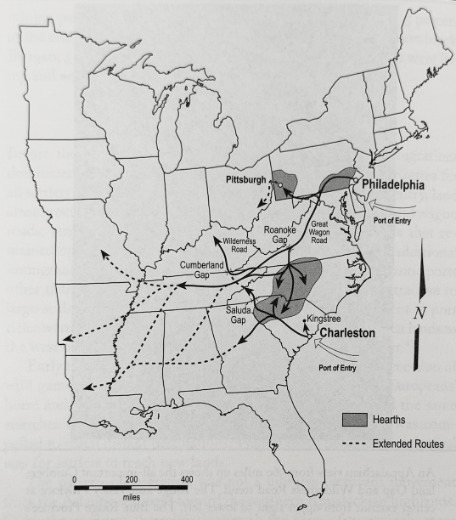
Our story resides in western North Carolina from the Appalachians to the Piedmont, but it begins farther north.[2] Immigrants from central Germany seeking economic relief and religious freedom began arriving in Philadelphia ports as early as 1681. Immigrants continued streaming in during the eighteenth century and establishing communities in southeastern Pennsylvania. These centers of culture, or hearths, were densely populated with Moravians, Mennonites, Lutherans, Calvinists, Dunkers, and Amish by the 1740s. As places became increasingly crowded right before the American Revolution, groups moved along established migration paths such as the Great Wagon Road (1720-1770) which starts in Philadelphia, cuts straight across Virginia, then turns south cutting across North Carolina (Figure 1).[3] The main settlements we will be focusing on are near Salem, Salisbury, and Charlotte, but much of the food and culture of other German hearths are very similar across Appalachia and Pennsylvania.[4]
Religion was a significant reason for the settlers’ migration, and remains central to their food and culture. Not least of which were the Moravians, a sect who considers food a significant part of their worship and fellowship.[5] They settled around Winston-Salem in the middle of the eighteenth century where they remain and continue to celebrate significant events and holidays with a Moravian Love Feast.[6]
Food culture historian and educator Lucy Long describes foodways as “all the activities surrounding food, as well as the ways in which people think and talk about food. This includes all the behind-the-scenes activities involved in producing that dish – procurement, preservation, preparation, distribution, consumption, and even cleanup.”[7] German foodways introduced new ingredients, recipes, and processes to existing Appalachian food culture. Pork and sausage, fermentation and canning, and baked goods such as cakes and cookies using wheat flour and molasses are all German in origin.[8]
Now that we know how the Germans got to Appalachia, we can better understand how their food culture influenced the culinary landscape of North Carolina. We will discuss recipe books, preparation methods, pork and related products, preservation and canning, and sweets and baked goods.
Cookbooks
Books of recipes help to shape a sense of regional cuisine and as a form of documentation.[9] There are two main types of cookbooks we encounter: ethnic cookbooks and community cookbooks. Ethnic cookbooks contain dishes of the region and ethnic group they describe, often adapt recipes to appeal to American audiences, and sometimes have historical anecdotes and context.[10] Community cookbooks are assembled by local organizations, often churches, whose members contribute recipes they like to cook and share, giving an authentic view of what foods people in the region actually made.[11] Because they are intended for use by members of their own community, they often don’t give much history or context.[12] Community cookbooks often mix German and non-German recipes together, presenting them on equal grounding as local favorites, highlighting true enmeshing of German food culture.[13]
One community cookbook from 1984, the Appalachian Heritage Cookbook by the Steelesburg Homemakers Club, blended different elements of homemaking into their cookbook. Each section divider had a different quilting pattern, and the book also includes notes such as cleaning tips and weight loss advice: this emphasizes how all of these activities were performed by the same people.[14]
Preparation Methods
As German populations and their foodways moved around, so too moved their food preparation methods. This includes preservation, cooking, and preparation techniques. Because travel was difficult in the Appalachian terrain and people had to provide food for themselves, food needed to be preserved to last through the winter. Canning was central to making food last. We will talk more about canning in the next section.
Local Cherokees’ preservation techniques were significant in southern Appalachian food culture: they taught European settlers drying techniques to make jerky from meat, how to preserve corn, the custom of storing food in gourds and skins, and how maple sugar or syrup can be used as a preservative.[15]
German frying methods of battering and searing foods were also introduced and caught on with other communities who adapted it to their needs and preferences, such as Cajuns who adapted the method to be spicy. (Note that this is different from deep-frying, which is an African technique.) Germans also introduced sweet and sour sauces such as the ones used in cabbage slaw and potato salads.[16] They also are credited with the concept of marinating meat, though this is somewhat contested. Processing meat into sausages is a German technique that was (and still is) extremely popular among Appalachian populations, and we will discuss this more in-depth later on.[17] Sausages, meatloaf, and scrapple (a spiced mush of pork scraps and meal, beloved by the Pennsylvania Dutch and other members of German hearths) are all traditionally German as well.[18] It is not uncommon for Appalachian cookbooks to include upwards of six meatloaf recipes.[19]
Other cooking methods the Germans introduced include using saffron as a spice;[20] making noodles like spaetzle out of flour, water, and egg;[21] and using large copper kettles over outdoor fires to make apple butter and kettle corn.[22] Baking techniques that originated with Germans include grinding almonds into marzipan for pastries and using buttermilk in baking.[23]
Pork and Ham
Hogs were the main source of meat in Appalachia. They were allowed to roam in the forests, eating oak acorns to their hearts’ content, fattening themselves up.[24] Anyone with at least an acre or two of land would raise hogs for food or money, and the mid-November slaughter was an important component of preparing for winter.[25] Beef was too expensive to raise or purchase, and difficult to preserve, so people would only really have them as beasts of burden. Beef in Appalachia only became prominent in the last century or so.[26]
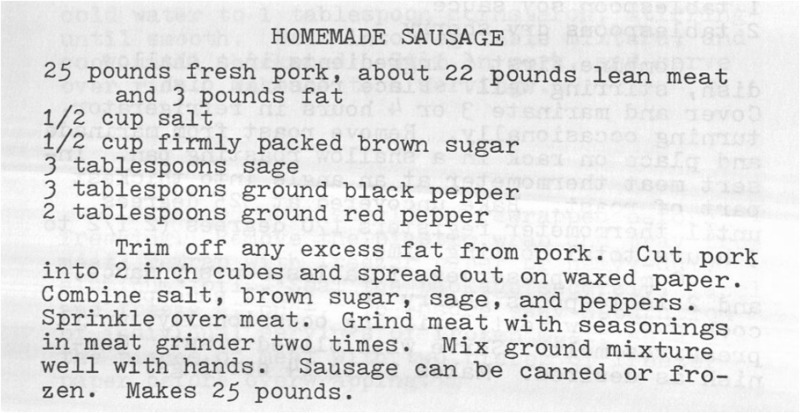
People would eat every part of the hogs, and pork products were eaten pretty much every day, perhaps at each meal.[27] Assorted parts were preserved for use in later recipes, such as ribs, organs, heart, tongue, intestines, stomach, feet, and ears.[28] Meat was salted or smoked for both flavor and preservation.[29] Baked or glazed hams, bacon, and salted meat (also known as fatback) were staple foods.[30] Lard was also used for flavoring. Intestines were used as sausage casings, and grilled bratwurst or kielbasa served potatoes and kraut were a common meal in hearths.[32] Many cookbooks would have a recipe for homemade sausage (Figure 2).
Many pork recipes demonstrate a merging with other food cultures, such as ham served with potatoes or cornbread, two very American foods.[33] Beans, another primary American food that Native peoples introduced to European settlers, also make appearances in dishes alongside German-origin foods. For example, one “Pork n’ Bean with Weiners” recipe from 1986 shows adaptation, even just in the name! The recipe calls for name-brand commercial ingredients, but the concept still stands.[34] Or, Potato-Sausage Soup recipes appear in many cookbooks.[35] One main example of enmeshing food cultures is barbeque. Southern sides like grits and hominy, Black cooks’ tomato-based sauces, and Anglo-American vinegar-based sauces accompanied German sausages for all manner of summer cookouts and holidays.[36]
Preservation and Pickling
Because preservation was so essential, communities developed a rich tradition of canning and pickling from the Germans. Before electricity made canning easier, pickling, drying, and salting were more prevalent methods of preservation. Vinegar was widely available because it is a byproduct of apples.[37] Apples grow very well in the region, store for a long time, and can be used in many desserts and sides, so most families had a small orchard on their land.[38]
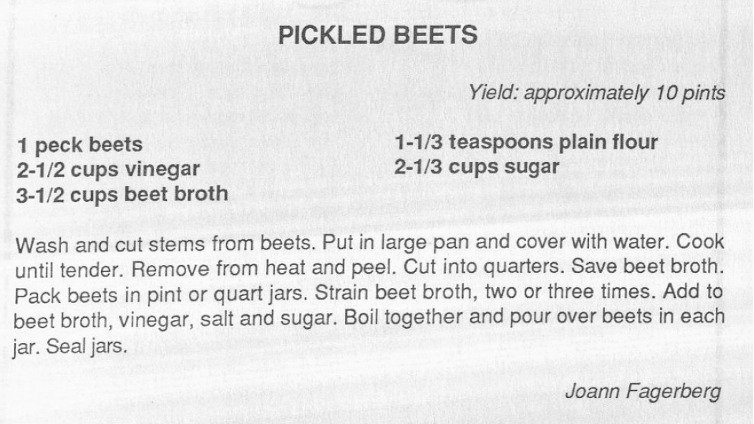
Though grocery stores and modern technology have decreased food scarcity today, the traditions live on: families still annually can and pickle foods from their gardens for consumption year-round or for the flavor. There is a heavy emphasis on local and seasonal ingredients because the preservation techniques are rooted in self-sufficiency and practicality.[39] Veggies, fruit, meat, and even fish such as herring were all pickled initially for preservation, then the tradition continued because it had become so integral to the cuisine.[40] Pickled beets are especially German in origin and remain popular in Southern cuisine (Figure 3).[41] Making preserves such as jams and jellies comes from the German tradition of plum butter, in which cooks boil down plums.[42] Pears are also very traditional.[43] The preserves sections of many cookbooks are long and detailed.
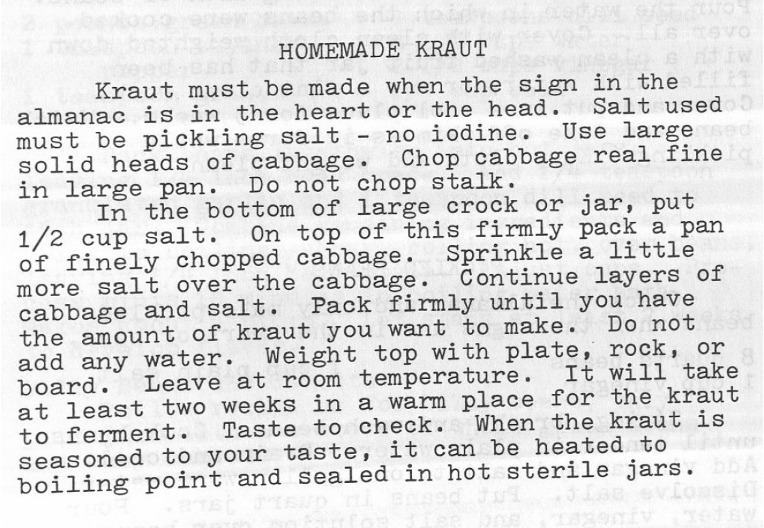
German traditions of sauerkraut is a touchstone of Southern food. Families kept special sauerkraut cutting boards for cutting and shredding cabbage, then would pack the cabbage and plenty of salt into pottery crocks for fermentation (Figure 4).[44] Cabbage was especially popular because it’s nutritious, grows very well in the mountains, grows almost year-round, and is inexpensive to cultivate.[45] Some cookbooks instructed cooks to make kraut only when the Almanac sign is in the head or neck for the highest quality kraut.[46]
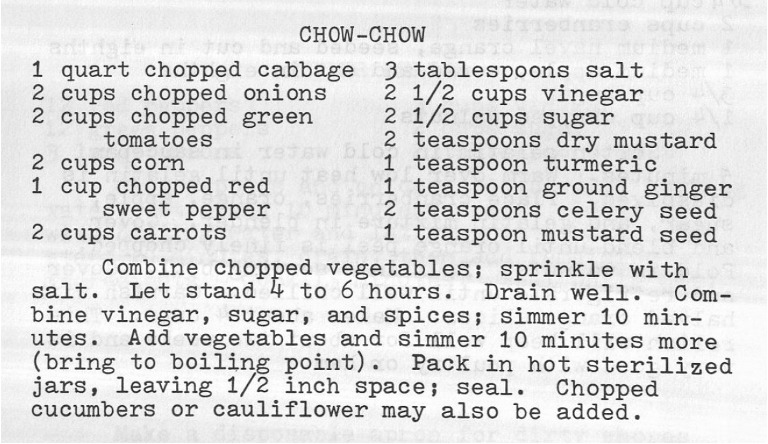
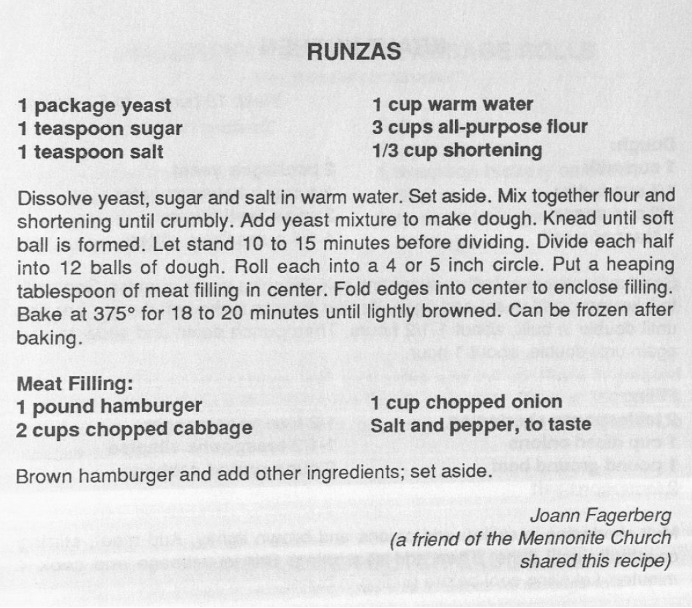
Pickled and canned items were often called-for in other recipes, such as chow-chow, a sort of Southern relish or chutney made of pickled cabbage, onion, corn, red pepper, and carrot (Figure 5).[47] One notable recipe that appears in multiple cookbooks is hamburger-and-cabbage-filled rolls, sometimes called Burocks, Runzas, or Kraut Kuchen (Figure 6). These traditional German buns were traditionally served during Oktoberfest then the Mennonites brought them to the Americas.[48]
Vegetables
Potatoes, sweet potatoes, bread and cornbread, and German rice provided starch in dishes.[49] Cabbage was central in the Appalachian diet, as were corn, beans, and squash which were staple foods for ancestral Native Americans.[50] Squash was wildly popular: some cookbooks had as many as ten separate squash casserole recipes![51] Beets were a side dish, condiment, and base for casseroles or salads.[52] Salads were a German invention: fresh vegetables with a vinegar dressing, or potato salad with a creamy or vinegar-based dressing. These salads became Americanized as traditional recipes started including items like Miracle Whip.[53] Pickles, of course, were extremely common as they could be preserved.
A vegetable that continually appears in Appalachian cookbooks is asparagus. Asparagus was a favorite vegetable in Germany, with some places even celebrating the first asparagus harvest as a holiday. In the late seventeenth century, William Penn wrote that asparagus grows well in American climes.[54] German settlers brought the Spargel with them as they migrated south. Appalachian cookbooks advise that fresh asparagus should be prepared by snapping the tough ends off, steaming the tender tips for a few minutes, and serving them with melted butter.[55] Others give recipes for asparagus casserole, soups, canning preparation, and pickling.[56]
Sweets and Baked Goods
Far and away, the baked goods and desserts sections of Appalachian cookbooks are where Germanic culinary traditions are most visible. Cakes, cookies, pies, and Christmas confections are the most popular recipes of German origin that make their way into Southern cookbooks. German influence can be seen across recipes through warm spices, molasses as a sweetener, emphasis on apricots and almonds, and creativity with apples.[57]
Cakes are the old standard baked goods in Appalachia, especially to celebrate occasions such as birthdays, family reunions, and holidays. Apples are very prominent in these desserts. One “Golden Apricot-Almond Fruitcake” recipe does not acknowledge its origins, but we know that it is an American transcription of the common Aprikosenkuchen or Marillenkuchen that are so well loved in Germany and Austria.[58] Other very German cakes that commonly appear in Southern cookbooks include walnut, chocolate almond, cinnamon, vinegar, many apple cakes (Apfelküchen or Apfelküchle), Linzer torte, Kummel tortes, and schaum torte (a type of meringue cake).[59] German Blatzkuchen (sometimes called Blechkuchen) recipes use lard.[60] Amish Shoo-fly pie is very popular in the south and uses lots of molasses.[61] These recipes also show a decent amount of American adaptation: one Mandelbrot (almond bread) is adapted with American ingredients, calling for maple syrup as its sweetener; other traditionally German cake recipes call for cake mixes or Crisco.[62]
Cookies: German cookies are beloved amongst Southerners. Moravian sugar cookies, gingerbread, ginger snaps, anise crisps, funnel cakes, and strudels all hail from German traditions.[63] Berlin Wreaths and Linzer Wreaths are common as well as all variations (and spellings) of snickerdoodles.[64] Hexenschnee (“Witches’ Snow”) is a type of mousse that calls for applesauce and apricot, two favorite ingredients in German baking.
Moravian Lovefeast buns are made with mashed potatoes as an ingredient.[65] Potato bread was a staple in Germany in the seventeenth and eighteenth centuries because adding potatoes to their daily bread ensured that families could have bread when food was scarce. This German resourcefulness translates well to Appalachia's tradition of preservation and rationing of food when necessary.
Christmas
Coffee cakes and Stollen (fruit cakes with icing) are favorites for Christmas.[66] Coffee cake is originally German, and almost any cookbook is sure to have at least one recipe for it if not its own whole section dedicated to it.[67] Applesauce Cake is a traditional Christmas or Yuletide dessert in mountainous regions of the south.[68]
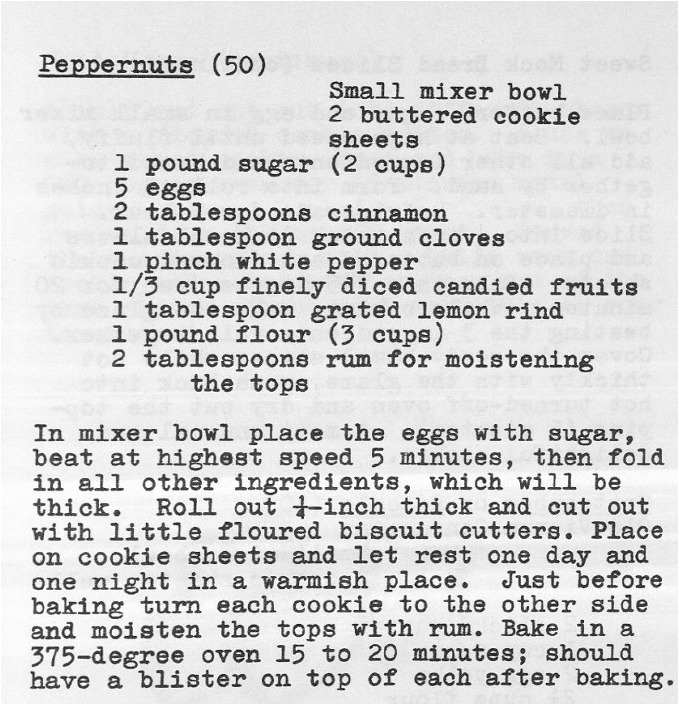
Cookies at Christmastime make for good treats and gifts. Lebkuchen are traditional German and Austrian confections made with nuts and warm spices. Some Appalachian recipes Americanize the treats and call for Bisquick.[69] Peppernuts (Pfeffernusse), small, hard, round cookies with a spicy, peppery taste and powdered sugar exterior, are extremely prominent in Appalachian cookbooks (Figure 7).[70] The cookies were even used to decorate Christmas trees! Marzipan confections would be molded into fun shapes, harkening back to German and Austrian Christmas and New Year’s traditions.[71]
Spiced Almonds or Pecans, sometimes just called Sugared Nuts, are the Appalachian recollection of the German Gebrannte Mandeln, or spiced almonds, commonly made and served at Christmastime and at Christmas markets.
Conclusion
The migration of peoples hundreds of years ago still affects southern foodways today. The cookbooks whose recipes are represented here are as recent as the 2000s, and these churches certainly still make these recipes as a community.
Cookbooks, both ethnic and community, represent German foodways as they existed and persist in Appalachia. Pork raising, preparation, and preservation remains central to Appalachian culture. Pickling and canning was and is an essential part of preserving food and remains an annual tradition for many families. Baked goods, especially around Christmas, are some of the clearest examples we have of German foods being adopted and shared. As German settlers moved and diffused, so too did their culture. The food culture the immigrants brought did not just affect the people who moved but also the people they interacted with: they both shared their food culture and adopted the ways of others, be it the foods or the preparation.
Endnotes
- This common German prayer has been as grace before meals in Germany and German-American homes for hundreds of years. Almost every Appalachian community cookbook of German recipes, especially from churches, will have this prayer in it or on the cover. One cookbook is even named Be our Guest, referencing the prayer: St John’s Lutheran Church (Winston-Salem, N.C.), (1986), Be our guest. St. John’s Lutheran Church.
- B. Rehder, (2004), Appalachian folkways, JHU Press, 14. Some geographers include the Piedmont in Appalachia, others don’t because of its more developed economy, but I argue that their shared traditional culture and folkways make both regions relevant to our discussion.
- Ibid., 56-7.
- Ibid., 66-7. The area between Catawba and Yadkin rivers is also a hearth. Germans chose lands based on their knowledge of soil quality, and land prices in PA and NC were comparable. There is an almost continuous line of German settlement north to PA.
- Crews, C. D. (2008). Around-the-World Moravian Unity Cookbook. Moravian Archives, Winston-Salem, North Carolina, 22.
- Trinity Moravian Church (Winston-Salem, N.C.). Women’s Fellowship. (1985). Bless these gifts. [Trinity Moravian Church].
- Long, L. M. (2009), Regional American food culture, Greenwood Press, xi.
- Stokes, A. Q., & Atkins-Sayre, W, (2024), Hungry Roots: How Food Communicates Appalachia's Search for Resilience, Univ of South Carolina Press, 12.
- Long, Regional American food culture, 105.
- Long, Regional American food culture, 107.
- Long, Regional American food culture, 108. Community cookbook authors often do not know or do not note the origins of their recipes. They are often transmitted over generations or passed between friends or neighbors. One churchwoman’s recipe for Pfeffernusse proudly called the cookies a Southern original.
- Clemmons Moravian Church (Clemmons, N.C.). (2002). A collection of recipes (Clemmons Moravian Women’s Fellowship (Clemmons, N.C.), Ed.). [Clemmons Moravian Women’s Fellowship].
- St. John’s Lutheran Church (Winston-Salem, N.C.). (1986). Be our guest. St. John’s Lutheran Church
- Steelesburg Homemakers Club. (1984). Appalachian Heritage Cookbook. Pocahontas Press.
- Long, Regional American food culture, 3-4.
- Ibid., 27-8, 30.
- Ekvall, E., & St Paul’s Episcopal Churchwomen (Winston-Salem, N.C.). (1966). The proof of the pudding: international foods. [Eva Ekvall?].
- Long, Regional American food culture, 126.
- Trinity Moravian Church, Bless these gifts. [Trinity Moravian Church].
- Long, Regional American food culture, 78.
- Ibid., 140.
- Ibid., 121.
- Ibid., 81.
- Rehder, Appalachian folkways, 26.
- Casada, J., & Pressley, T. (2023). Celebrating Southern Appalachian Food: Recipes & Stories from Mountain Kitchens. Arcadia Publishing. 47.
- Ibid., 67.
- Ibid., 49.
- Rehder, Appalachian folkways, 216.
- Ibid.
- Casada & Pressley, Celebrating Southern Appalachian Food: Recipes & Stories from Mountain Kitchens, 16, 49, 52-3.
- Rehder, Appalachian folkways, 26.
- Long, Regional American food culture, 88, 148.
- Casada & Pressley, Celebrating Southern Appalachian Food: Recipes & Stories from Mountain Kitchens, 50-1.
- Melugin, M. (2025). Pork ’n Beans: the more you eat, the more you…. – Grub Americana. Grubamericana.com. https://grubamericana.com/2025/05/06/pork-n-beans-the-more-you-eat-the-more-you/.
- Clemmons Moravian Church, A collection of recipes, 34.
- Long, Regional American food culture, 186.
- Casada & Pressley, Celebrating Southern Appalachian Food: Recipes & Stories from Mountain Kitchens, 177.
- Ibid., 147.
- Stokes & Atkins-Sayre, Hungry Roots: How Food Communicates Appalachia's Search for Resilience, 12, 44.
- Casada & Pressley, Celebrating Southern Appalachian Food: Recipes & Stories from Mountain Kitchens, 177. Crews, Around-the-World Moravian Unity Cookbook, 23
- Steelesburg Homemakers Club, Appalachian Heritage Cookbook, 244, 246.
- Long, Regional American food culture, 71.
- Casada & Pressley, Celebrating Southern Appalachian Food: Recipes & Stories from Mountain Kitchens, 189.
- Long, Regional American food culture, 121.
- Casada & Pressley, Celebrating Southern Appalachian Food: Recipes & Stories from Mountain Kitchens, 134.
- Steelesburg Homemakers Club, Appalachian Heritage Cookbook. Casada & Pressley, Celebrating Southern Appalachian Food: Recipes & Stories from Mountain Kitchens, 182-3.
- Steelesburg Homemakers Club, Appalachian Heritage Cookbook, 242.
- St John’s Lutheran Church, Be our guest, 177.
- St John’s Lutheran Church, Be our guest, 352. Steelesburg Homemakers Club, Appalachian Heritage Cookbook.
- Rehder, Appalachian folkways, 216.
- Trinity Moravian Church, Bless these gifts.
- Steelesburg Homemakers Club, Appalachian Heritage Cookbook, 287-9. St John’s Lutheran Church, Be our guest, 50.
- Ibid., 268.
- Murphy, Andrew R. (8 October 2018). William Penn: A Life. Oxford University Press.
- Crews, Around-the-World Moravian Unity Cookbook, 37.
- Ekvall, & St Paul’s Episcopal Churchwomen, The proof of the pudding: international foods, 11.
- Clemmons Moravian Church, A collection of recipes, 134.
- St John’s Lutheran Church, Be our guest, 426.
- Ibid., 430-52.
- Ibid., 490.
- Ibid., 547.
- Ibid.
- Ibid., 446-7. One gingerbread recipe claimed the confection as an originally Southern creation. Talk about a total Mischung of traditions!; Long, Regional American food culture, 143, 152.
- St John’s Lutheran Church, Be our guest, 562.
- Trinity Moravian Church, Bless these gifts, 36.
- Long, Regional American food culture, 194.
- Casada & Pressley, Celebrating Southern Appalachian Food: Recipes & Stories from Mountain Kitchens, 191.
- Casada & Pressley, Celebrating Southern Appalachian Food: Recipes & Stories from Mountain Kitchens, 199. One recipe even has the tagline “Can’t imagine Christmas without it,” showing how central these desserts were to marking the season.
- Ekvall, & St Paul’s Episcopal Churchwomen, The proof of the pudding: international foods, 219.
- St John’s Lutheran Church, Be our guest, 556.
- Long, Regional American food culture, 195.
References
Casada, J., & Pressley, T. (2023). Celebrating Southern Appalachian Food: Recipes & Stories from Mountain Kitchens. Arcadia Publishing.
Clemmons Moravian Church (Clemmons, N.C.). (2002). A collection of recipes (Clemmons Moravian Women’s Fellowship (Clemmons, N.C.), Ed.). [Clemmons Moravian Women’s Fellowship].
Cookbook: in celebration of our 20th anniversary. (1997). [Salem Chapter of the American Needlepoint Guild].
Crews, C. D. (2008). Around-the-World Moravian Unity Cookbook. Moravian Archives, Winston-Salem, North Carolina.
Ekvall, E., & St Paul’s Episcopal Churchwomen (Winston-Salem, N.C.). (1966). The proof of the pudding: international foods. [Eva Ekvall?].
Long, L. M. (2009). Regional American food culture. Greenwood Press.
Melugin, M. (2025). Pork ’n Beans: the more you eat, the more you…. – Grub Americana. Grubamericana.com. https://grubamericana.com/2025/05/06/pork-n-beans-the-more-you-eat-the-more-you/.
Murphy, Andrew R. (8 October 2018). William Penn: A Life. Oxford University Press.
Rehder, J. B. (2004). Appalachian folkways. JHU Press.
Steelesburg Homemakers Club. (1984). Appalachian Heritage Cookbook. Pocahontas Press.
Though this cookbook originates in Blacksburg, Virginia, I argue this volume is relevant to our discussion because it is so nearby Salem-area and the communities developed parallel to each other. The German recipes and culture of the Salem area are related by region and path of immigration, not state lines.
Stokes, A. Q., & Atkins-Sayre, W. (2024). Hungry Roots: How Food Communicates Appalachia's Search for Resilience. Univ of South Carolina Press.
St John’s Lutheran Church (Winston-Salem, N.C.). (1986). Be our guest. St. John’s Lutheran Church.
Trinity Moravian Church (Winston-Salem, N.C.). Women’s Fellowship. (1985). Bless these gifts. [Trinity Moravian Church].


